Industrial chillers are an essential part of many manufacturing and commercial processes. They are designed to remove heat from equipment, machinery, or production systems and maintain a stable operating temperature.
Introduction Industrial chillers are an essential part of many manufacturing and commercial processes. They are designed to remove heat from equipment, machinery, or production systems and maintain a stable operating temperature. By controlling heat, industrial chillers help improve equipment performance, reduce downtime, and support consistent product quality. Many industries depend on industrial chillers, including advanced industrial chiller systems and process water chillers, to maintain stable temperatures and support continuous production. This guide explores the different types of industrial chillers, their practical applications, advantages, limitations, recent innovations, and important factors to consider before selecting a system. Whether you are learning about industrial cooling for educational purposes or researching different solutions, understanding the basics can help you make informed decisions.
What Is an Industrial Chiller?
An industrial chiller is a cooling system that removes heat from equipment or manufacturing processes. Modern industrial chiller systems typically circulate chilled water or a water-glycol mixture to absorb excess heat before it is cooled and reused.
Industrial chillers differ from residential air conditioners because they are designed to support continuous industrial operations and larger cooling capacities.
Why Industrial Chillers Matter
Temperature control affects nearly every industrial process. Excessive heat can lead to:
Reduced equipment efficiency
Product quality issues
Increased wear on machinery
Unexpected production downtime
Higher maintenance requirements
Proper cooling helps maintain stable operations while protecting valuable equipment.
Benefits of Industrial Chillers
Industrial chillers provide several advantages across different industries.
Benefit | Description |
Stable Temperature Control | Maintains consistent process temperatures |
Equipment Protection | Prevents overheating and component damage |
Improved Product Quality | Supports uniform production conditions |
Energy Efficiency | Many modern systems reduce overall energy consumption |
Reduced Downtime | Minimizes unexpected equipment failures |
Long Equipment Life | Lower operating temperatures reduce wear |
Limitations of Industrial Chillers
Although industrial chillers offer many benefits, they also have certain limitations.
Limitation | Explanation |
High Initial Investment | Large systems may require significant installation costs |
Regular Maintenance | Cleaning and inspections are necessary for reliable operation |
Space Requirements | Some systems require dedicated installation areas |
Energy Consumption | Older models may consume considerable electricity |
Water Management | Water-cooled systems require proper water treatment |
Understanding these limitations helps organizations plan maintenance and operating costs more effectively.
Different Types of Industrial Chillers
Industrial chillers are available in several configurations. Each type is designed for specific cooling requirements.
1. Air-Cooled Industrial Chillers
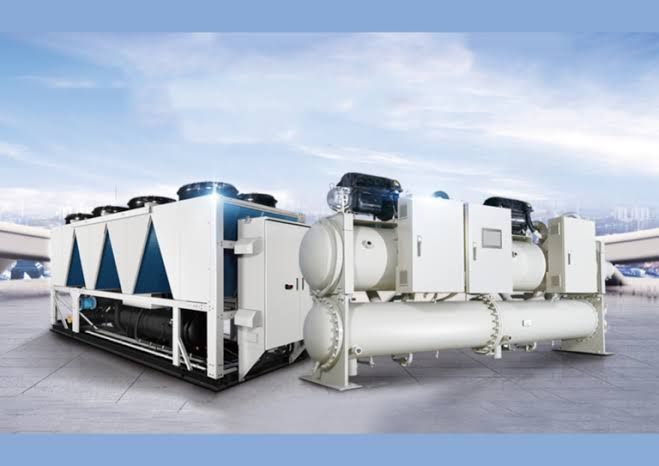
Air-cooled chillers remove heat using ambient air through condenser fans.
Common Applications
Commercial buildings
Plastic manufacturing
Printing facilities
Small manufacturing plants
Laboratories
Advantages
Easier installation
Lower maintenance
No cooling tower required
Suitable for locations with limited water supply
Limitations
Less efficient in very hot climates
Outdoor installation often required
Fan noise may be higher
2. Water-Cooled Industrial Chillers
Water-cooled chillers remove heat using cooling towers or condenser water systems.
Common Applications
Large manufacturing facilities
Hospitals
Data centers
Chemical plants
Pharmaceutical manufacturing
Advantages
Higher energy efficiency
Better performance in continuous operations
Longer equipment life
Suitable for large cooling loads
A water cooled chiller is commonly used in facilities with high cooling demands because it offers efficient heat removal through cooling towers. To maintain water quality and reduce scaling or corrosion, many organizations work with cooling tower treatment companies as part of their maintenance strategy.
Limitations
Requires cooling tower
Higher installation cost
Water treatment required
3. Portable Industrial Chillers
Portable chillers combine cooling components into a compact movable unit.
Applications
Laser machines
Welding equipment
Medical devices
Laboratory testing
Temporary cooling requirements
Advantages
Compact design
Easy relocation
Quick installation
Limitations
Lower cooling capacity
Limited for smaller applications
For example, a Mokon portable chiller is one type of portable cooling solution used in laboratories, plastics manufacturing, and industrial testing environments. Similar portable chillers are also available from other manufacturers.
4. Scroll Chillers
Scroll compressors are commonly used in medium-sized industrial cooling systems.
Best For
Food processing
Medical equipment
HVAC systems
Plastic molding
Advantages
Quiet operation
Reliable performance
Lower maintenance
5. Screw Chillers
Screw chillers use rotary screw compressors designed for continuous industrial operations.
Applications
Manufacturing plants
Chemical industries
Heavy industrial production
Advantages
High cooling capacity
Reliable for continuous operation
Efficient under varying loads
6. Centrifugal Chillers
Centrifugal chillers are typically used for very large cooling requirements.
Applications
Airports
Large hospitals
Universities
Industrial campuses
Advantages
Extremely high capacity
Excellent efficiency at full load
Suitable for centralized cooling
7. Absorption Chillers
Unlike conventional chillers, absorption chillers use heat sources rather than mechanical compressors.
Possible heat sources include:
Steam
Hot water
Waste heat
Natural gas
Applications
Industrial plants
Combined heat and power systems
Facilities recovering waste heat
Advantages
Lower electricity consumption
Utilizes available waste heat
Suitable for energy recovery systems
Comparison of Industrial Chiller Types
Chiller Type | Efficiency | Installation Cost | Maintenance | Typical Applications |
Air-Cooled | Moderate | Lower | Low | Commercial buildings |
Water-Cooled | High | Higher | Moderate | Manufacturing |
Portable | Moderate | Low | Low | Laboratories |
Scroll | High | Moderate | Low | HVAC |
Screw | High | Moderate-High | Moderate | Industrial plants |
Centrifugal | Very High | High | Moderate | Large facilities |
Absorption | High (using waste heat) | High | Moderate | Energy recovery |
Practical Applications Across Industries
Industrial chillers are used in many sectors.
Manufacturing
CNC machines
Injection molding
Metal processing
Laser cutting
Consistent cooling helps improve production quality.
Food and Beverage
Applications include:
Beverage production
Dairy processing
Cold storage
Brewing
Temperature control supports product consistency and food safety.
Pharmaceutical Industry
Industrial chillers help maintain stable temperatures during:
Drug manufacturing
Laboratory testing
Chemical reactions
Storage environments
Plastics Industry
Plastic injection molding relies heavily on cooling.
Industrial chillers help:
Reduce cycle times
Improve mold quality
Increase production consistency
Chemical Processing
Many chemical reactions generate heat.
Chillers maintain safe operating temperatures while supporting product quality.
Medical Equipment
Applications include:
MRI machines
CT scanners
Laboratory analyzers
Medical lasers
Reliable cooling helps maintain equipment performance.
Data Centers
Servers generate significant heat.
Industrial cooling systems help maintain stable temperatures that reduce equipment stress and improve operational reliability.
Latest Trends in Industrial Chillers
Industrial cooling technology continues to evolve.
Some notable trends include:
Smart Monitoring
Modern chillers often include sensors that monitor:
Temperature
Pressure
Flow rates
Energy usage
These systems help identify maintenance needs before failures occur.
Variable Speed Compressors
Variable-speed technology adjusts compressor operation based on cooling demand.
Benefits include:
Lower energy consumption
Improved efficiency
Reduced operating costs
Eco-Friendly Refrigerants
Manufacturers are increasingly adopting refrigerants with lower environmental impact while meeting updated environmental regulations.
Remote Monitoring
Many industrial chillers now support remote diagnostics, allowing operators to monitor system performance from computers or mobile devices.
Predictive Maintenance
Artificial intelligence and machine learning are gradually being integrated into industrial cooling systems to detect potential issues early and improve maintenance planning.
Key Features to Consider
When evaluating industrial chillers, consider the following features.
Feature | Why It Matters |
Cooling Capacity | Must match process requirements |
Energy Efficiency | Reduces operating costs |
Compressor Type | Affects reliability and performance |
Refrigerant | Environmental and regulatory considerations |
Noise Level | Important for indoor installations |
Controls | Easy monitoring and operation |
Maintenance Access | Simplifies servicing |
Safety Features | Protects equipment and operators |
Top Industrial Chiller Manufacturers
Several companies manufacture industrial chillers for different industries.
Company | Known For |
Carrier | Commercial and industrial HVAC solutions |
Trane | Large industrial cooling systems |
Daikin | Energy-efficient chiller technologies |
Johnson Controls (YORK) | Large-scale industrial chillers |
Mitsubishi Electric | Advanced cooling technologies |
Smardt | Oil-free centrifugal chillers |
Thermal Care | Process cooling systems |
Motivair | Precision cooling solutions |
Drake Refrigeration | Industrial process cooling |
G&D Chillers | Custom industrial chillers |
Each manufacturer offers different product ranges depending on cooling capacity, industry requirements, and regional availability.
How to Choose the Right Industrial Chiller
Selecting the right system depends on several factors.
Consider this checklist:
Determine the required cooling capacity.
Understand the operating environment.
Compare air-cooled and water-cooled options.
Evaluate available installation space.
Consider future expansion needs.
Review maintenance requirements.
Compare energy efficiency ratings.
Check compatibility with existing equipment.
Consider total operating costs instead of purchase price alone.
Verify local service and replacement part availability.
Best Practices for Operation and Maintenance
Proper maintenance improves performance and extends equipment life.
Recommended practices include:
Clean condenser coils regularly.
Monitor refrigerant levels.
Inspect pumps and piping.
Replace filters as recommended.
Check electrical connections.
Monitor operating temperatures.
Inspect water quality in water-cooled systems.
Schedule preventive maintenance.
Record operating data for trend analysis.
Follow manufacturer maintenance schedules.
Routine inspections often help detect small issues before they become costly repairs.
Frequently Asked Questions
What is the difference between an air-cooled and water-cooled chiller?
Air-cooled chillers use ambient air to remove heat, while water-cooled chillers rely on cooling towers or condenser water systems. Water-cooled models generally offer higher efficiency for large industrial applications.
Which industries use industrial chillers most often?
Industrial chillers are commonly used in manufacturing, pharmaceuticals, plastics, food processing, chemical plants, data centers, hospitals, laboratories, and commercial HVAC systems.
How long do industrial chillers typically last?
With proper maintenance, many industrial chillers operate effectively for 15–25 years, although lifespan depends on operating conditions, maintenance practices, and equipment quality.
Are industrial chillers energy efficient?
Modern industrial chillers often include variable-speed compressors, advanced controls, and improved refrigerants that help reduce energy consumption compared with older systems.
How often should industrial chillers be serviced?
Routine inspections are commonly performed monthly, while comprehensive preventive maintenance is typically scheduled every six to twelve months, depending on operating conditions and manufacturer recommendations.
Can industrial chillers operate continuously?
Yes. Many industrial chillers are designed for continuous operation in manufacturing and process cooling environments when properly maintained.
What factors affect chiller efficiency?
Efficiency depends on compressor type, condenser design, refrigerant selection, ambient conditions, maintenance practices, cooling load, and system controls.
Conclusion
Understanding industrial chillers, including process water chillers, industrial chiller systems, and water cooled chillers, helps users choose appropriate cooling solutions for different industrial applications. From air-cooled and water-cooled systems to portable, scroll, screw, centrifugal, and absorption chillers, each type is designed to meet different operational needs and cooling capacities.
Understanding the strengths, limitations, and practical applications of each chiller type can help businesses, engineers, facility managers, and learners make informed decisions based on their specific requirements. Considering factors such as cooling capacity, energy efficiency, maintenance needs, installation space, and long-term operating costs provides a more complete view when evaluating industrial cooling systems.
As technology continues to advance through smart monitoring, predictive maintenance, variable-speed compressors, and environmentally conscious refrigerants, industrial chillers are becoming more efficient and adaptable. Staying informed about these developments can support better planning, improved equipment reliability, and more sustainable cooling practices across a wide range of industries.