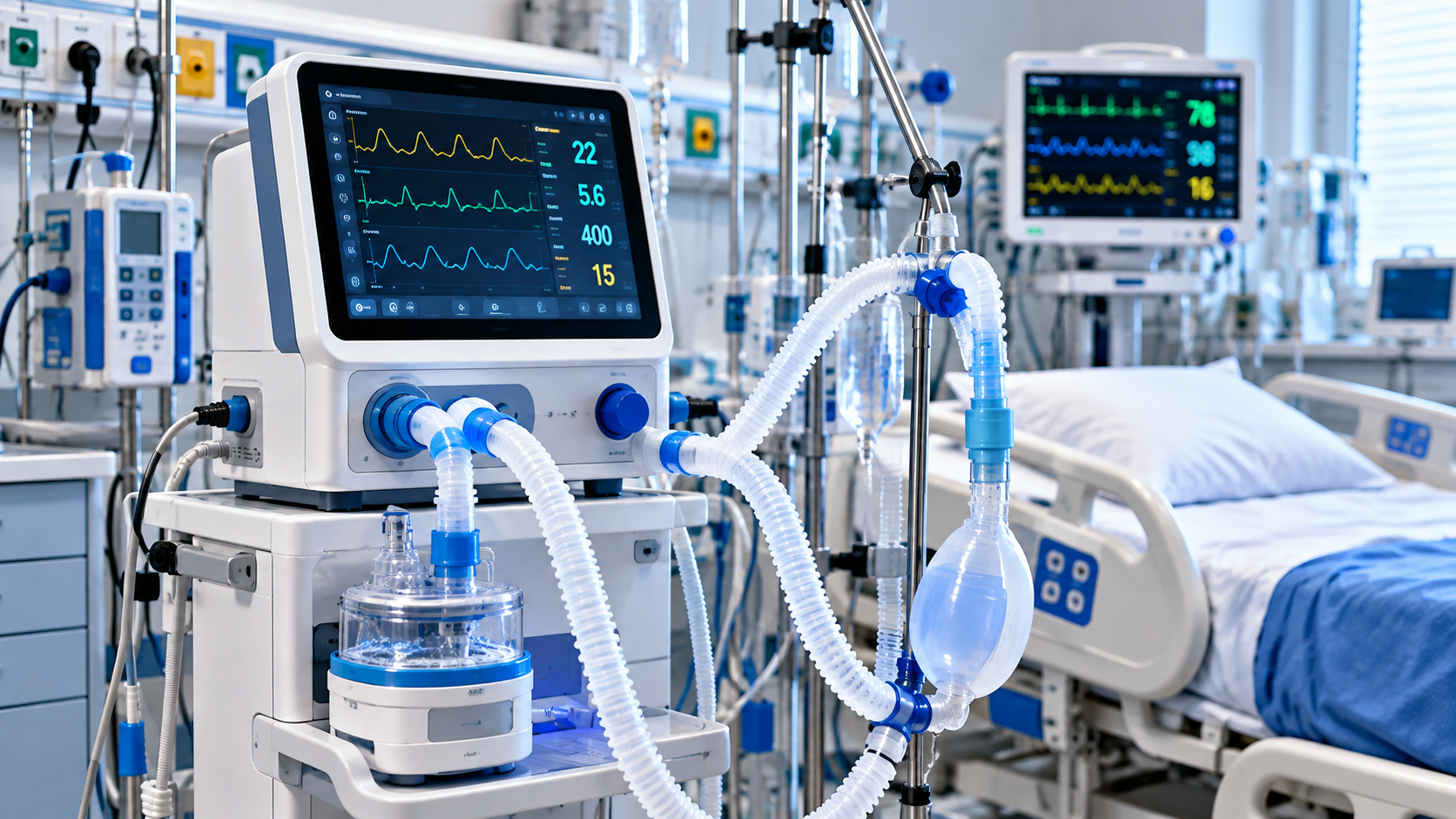
A ventilator machine is a medical device that supports or replaces a patient's breathing when the respiratory system cannot provide adequate ventilation independently.
It delivers controlled amounts of air and oxygen through an invasive breathing tube or a noninvasive mask, helping maintain gas exchange while medical professionals manage the underlying condition.
Modern ventilator machines combine electronic controls, respiratory monitoring, adjustable ventilation modes, alarm systems, and intelligent monitoring features. These technologies support critical care in intensive care units (ICUs), emergency departments, operating rooms, neonatal units, and specialized healthcare facilities.
Quick Facts About Ventilator Machines
The following table summarizes the main characteristics of modern mechanical ventilation systems.
Feature | Details |
|---|---|
Medical Device Name | Mechanical Ventilator |
Primary Purpose | Support or assist breathing |
Main Function | Deliver controlled respiratory support |
Common Locations | ICUs, operating rooms, emergency departments |
Ventilation Methods | Invasive and noninvasive |
Main Operating Principle | Positive-pressure ventilation |
Important Settings | Tidal volume, respiratory rate, FiO₂, PEEP, and pressure support |
Monitoring Parameters | Airway pressure, respiratory rate, oxygen saturation, and exhaled volume |
Main Components | Gas delivery system, sensors, display, valves, and alarms |
Common Patient Groups | Adults, children, and newborns |
Main Technologies | Electronic controls, digital monitoring, and automated adjustments |
Relevant Standard | ISO 80601-2-12 |
What Is a Ventilator Machine?
A ventilator machine, also called a mechanical ventilator or breathing machine, is a medical device designed to provide respiratory support when a patient cannot breathe effectively without assistance.
It moves air and oxygen into the lungs using controlled pressure and airflow. Depending on the patient's condition, the machine may deliver complete breathing support or assist the patient's own respiratory effort.
Mechanical ventilation is commonly used when respiratory failure, severe lung disease, neurological conditions, major surgery, or other medical problems interfere with normal breathing.
A ventilator does not directly cure the condition causing respiratory failure. Instead, it supports breathing and gas exchange while healthcare professionals treat the underlying illness.
Modern ventilators also provide continuous information about respiratory performance. Clinicians use these measurements to assess patient response and adjust treatment according to individual clinical requirements.
Why Ventilator Machines Matter in Critical Care
Breathing is necessary to supply oxygen to body tissues and remove carbon dioxide produced through normal metabolism. When the respiratory system cannot maintain adequate gas exchange, organs may not receive sufficient oxygen or eliminate carbon dioxide effectively.
Mechanical ventilation provides respiratory support during these situations. It helps maintain ventilation while medical teams investigate and treat the underlying condition.
Several functions explain the importance of ventilator machines in critical care.
Respiratory support: Assists or replaces spontaneous breathing when respiratory function is inadequate.
Oxygenation management: Allows clinicians to control the oxygen concentration delivered to the patient.
Carbon dioxide removal: Supports ventilation to help eliminate carbon dioxide.
Breathing pattern control: Provides adjustable respiratory rates, pressures, and volumes.
Continuous monitoring: Displays information about respiratory mechanics and equipment performance.
Treatment flexibility: Supports different ventilation strategies as a patient's clinical condition changes.
Ventilators are particularly important in intensive care because critically ill patients may require continuous respiratory support alongside other forms of organ monitoring and treatment.
How Does a Ventilator Machine Work?
A mechanical ventilator generally uses positive pressure to move gas into the lungs. Unlike normal spontaneous breathing, which creates negative pressure through respiratory muscle activity, mechanical ventilation pushes gas into the respiratory system.
The machine controls gas delivery according to programmed settings and the selected ventilation mode.
1. Gas Supply and Preparation
The ventilator receives medical air and oxygen through an approved gas supply or an integrated gas source, depending on its design.
The machine regulates the gas mixture to achieve the prescribed fraction of inspired oxygen (FiO₂).
2. Airflow and Pressure Regulation
Internal valves and control mechanisms regulate the flow of gas delivered during inspiration. Sensors monitor pressure and flow to help the ventilator maintain the selected operating parameters.
3. Delivery of the Inspiratory Breath
The ventilator delivers a breath through an endotracheal tube, tracheostomy tube, or noninvasive breathing interface.
The amount of gas and the pressure pattern depend on the selected ventilation strategy.
4. Expiration and Exhaled Gas Monitoring
After inspiration, the patient exhales through the breathing circuit. The ventilator measures relevant respiratory information, including exhaled volume and airway pressure.
Some systems maintain positive end-expiratory pressure (PEEP) to help prevent alveolar collapse.
5. Continuous Respiratory Monitoring
Sensors continuously collect information about airflow, pressure, respiratory timing, and other available parameters.
The ventilator displays these measurements so clinicians can assess respiratory performance and identify potential problems.
6. Alarm Management and Clinical Adjustment
When monitored conditions move outside configured limits, the ventilator generates visual or audible alarms.
Qualified healthcare professionals assess the situation and determine whether an adjustment, equipment inspection, or clinical intervention is required.
The following table summarizes the basic operating sequence.
Stage | System Function | Main Activity |
|---|---|---|
1 | Gas supply | Receives medical air and oxygen |
2 | Gas regulation | Controls gas mixture and airflow |
3 | Inspiration | Delivers respiratory support |
4 | Expiration | Allows exhalation and measures respiratory output |
5 | Monitoring | Tracks respiratory parameters |
6 | Alarm management | Communicates abnormal conditions |
Main Types of Ventilator Machines
Ventilator machines are classified according to their patient interface, intended clinical environment, patient population, and ventilation technology. Understanding these distinctions helps explain why different systems are used in critical care.
1. Invasive Mechanical Ventilators
Invasive ventilators provide respiratory support through an artificial airway inserted into the patient's respiratory tract.
Common interfaces include:
Endotracheal tubes inserted through the mouth or nose.
Tracheostomy tubes placed through a surgically created opening in the neck.
These ventilators are commonly used in intensive care when patients cannot maintain adequate breathing independently or require controlled respiratory support.
Main characteristics:
Supports controlled and assisted breathing.
Provides adjustable pressure and volume parameters.
Includes advanced respiratory monitoring.
Supports multiple ventilation modes.
2. Noninvasive Ventilators
Noninvasive ventilation delivers respiratory support through an external interface, usually a face mask or nasal mask, without requiring an endotracheal tube.
It is used in selected patients who can maintain airway protection and are suitable for noninvasive respiratory support.
Main characteristics:
Uses a mask-based breathing interface.
Supports spontaneous respiratory effort.
Can provide different inspiratory and expiratory pressures.
Requires monitoring for treatment response and signs of failure.
3. ICU Ventilators
Intensive care unit ventilators are designed for critically ill patients who require advanced respiratory support and continuous monitoring.
These systems generally provide multiple ventilation modes, adjustable respiratory parameters, advanced alarms, and detailed respiratory measurements.
Main characteristics:
Designed for high-acuity critical care environments.
Supports invasive and, depending on the model, noninvasive ventilation.
Provides advanced respiratory monitoring.
Includes configurable alarms and clinical data displays.
4. Transport Ventilators
Transport ventilators are portable systems designed to maintain respiratory support while patients move between healthcare locations.
They are used during transfers within hospitals, emergency transportation, and other approved medical transport situations.
Main characteristics:
Compact and portable construction.
Designed for operation during patient movement.
May include battery-powered operation.
Provides essential ventilation controls and monitoring.
5. Neonatal Ventilators
Neonatal ventilators are specifically designed to support newborns, including premature infants with underdeveloped respiratory systems.
Their design accommodates the different respiratory characteristics and smaller lung volumes associated with neonatal patients.
Main characteristics:
Designed for neonatal respiratory requirements.
Provides precise control of respiratory support.
Includes sensitive pressure and flow monitoring.
May support specialized neonatal ventilation modes.
6. Home Ventilators
Home ventilators provide long-term respiratory support for selected patients who require assistance outside a hospital environment.
These systems are used under clinical supervision and require appropriate equipment configuration, caregiver education, and ongoing monitoring.
Main characteristics:
Designed for extended respiratory support.
May provide invasive or noninvasive ventilation.
Often includes portable configurations.
Requires appropriate maintenance and emergency planning.
Ventilator Machine Type Comparison
The following table compares common ventilator categories by their intended environment and primary characteristics.
Ventilator Type | Primary Environment | Patient Category | Main Purpose |
|---|---|---|---|
Invasive Ventilator | Hospital and ICU | Patients requiring artificial airway support | Controlled or assisted ventilation |
Noninvasive Ventilator | Hospital and selected home settings | Suitable spontaneously breathing patients | Mask-based respiratory assistance |
ICU Ventilator | Intensive care unit | Critically ill patients | Advanced respiratory support |
Transport Ventilator | Ambulances and hospital transfers | Patients requiring ventilation during movement | Portable respiratory support |
Neonatal Ventilator | Neonatal intensive care | Newborns and premature infants | Specialized neonatal ventilation |
Home Ventilator | Residential care | Patients requiring long-term support | Extended respiratory assistance |
These categories are not entirely separate. For example, an ICU ventilator may support both invasive and noninvasive ventilation, while a transport ventilator may also be designed for use with different patient populations.
Ventilator Modes and Their Clinical Functions
Ventilation modes determine how a ventilator delivers breaths, responds to patient effort, and controls respiratory support.
The correct mode depends on the patient's respiratory condition, lung mechanics, clinical objectives, and response to treatment. No single mode is appropriate for every patient.
1. Volume-Controlled Ventilation
Volume-controlled ventilation delivers a preset tidal volume with each controlled breath.
Airway pressure changes according to respiratory system resistance and compliance.
Main characteristics:
Targets a defined inspiratory volume.
Allows clinicians to monitor pressure changes.
Requires attention to airway pressure and lung mechanics.
2. Pressure-Controlled Ventilation
Pressure-controlled ventilation delivers breaths using a specified inspiratory pressure over a defined period.
The delivered tidal volume can change depending on lung compliance, airway resistance, and other respiratory conditions.
Main characteristics:
Controls inspiratory pressure.
Delivered volume may vary.
Supports monitoring of respiratory mechanics.
3. Assist-Control Ventilation
Assist-control ventilation provides a minimum supported breathing frequency while also responding to detected patient inspiratory efforts.
A patient-triggered breath receives the ventilator's configured support.
Main characteristics:
Supports spontaneous triggering.
Maintains a minimum mandatory breathing frequency.
Provides consistent support according to the selected control strategy.
4. Synchronized Intermittent Mandatory Ventilation
Synchronized intermittent mandatory ventilation (SIMV) provides scheduled mandatory breaths while allowing spontaneous breathing between them.
Depending on the configuration, additional pressure support may be provided during spontaneous breaths.
Main characteristics:
Combines mandatory and spontaneous breathing.
Synchronizes mandatory breaths with patient effort.
Allows different levels of respiratory assistance.
5. Pressure Support Ventilation
Pressure support ventilation (PSV) assists spontaneous inspiration by providing a preset level of inspiratory pressure.
The patient initiates each supported breath, making the mode dependent on spontaneous respiratory effort.
Main characteristics:
Supports patient-initiated breathing.
Reduces the work required for inspiration.
Commonly used during selected spontaneous breathing assessments and ventilator liberation processes.
6. Continuous Positive Airway Pressure
Continuous positive airway pressure (CPAP) maintains positive airway pressure throughout spontaneous breathing.
It is commonly delivered through noninvasive interfaces, although CPAP can also be provided through an invasive airway in appropriate clinical settings.
Main characteristics:
Maintains continuous positive airway pressure.
Requires spontaneous respiratory effort.
Helps maintain airway and alveolar pressure.
Important Ventilator Settings and Monitoring Parameters
Modern ventilator machines display several measurements that help healthcare professionals evaluate respiratory support.
The following table explains commonly monitored parameters.
Parameter | Full Form | Clinical Meaning |
|---|---|---|
FiO₂ | Fraction of Inspired Oxygen | Oxygen concentration delivered to the patient |
PEEP | Positive End-Expiratory Pressure | Pressure maintained at the end of expiration |
Tidal Volume | VT | Volume of gas delivered or exhaled per breath |
Respiratory Rate | RR | Number of breaths per minute |
Peak Inspiratory Pressure | PIP | Maximum airway pressure during inspiration |
Minute Ventilation | VE | Total volume of gas moved per minute |
Pressure Support | PS | Additional inspiratory pressure provided during spontaneous breathing |
SpO₂ | Peripheral Oxygen Saturation | Estimated oxygen saturation measured by pulse oximetry |
These parameters must be interpreted together with the patient's clinical condition. A displayed value should not be considered independently when assessing respiratory performance.
Main Components of a Modern Ventilator Machine
A ventilator consists of interconnected mechanical, electronic, and pneumatic components that work together to deliver and monitor respiratory support.
Component | Function | Technical Role |
|---|---|---|
Gas Inlet System | Receives medical gases | Connects to air and oxygen supplies |
Gas Mixing Unit | Regulates oxygen concentration | Controls the delivered gas mixture |
Flow Control Valves | Regulate airflow | Manage inspiratory gas delivery |
Breathing Circuit | Connects the ventilator to the patient | Transfers respiratory gases |
Pressure Sensors | Measure airway pressure | Monitor respiratory pressure |
Flow Sensors | Measure gas movement | Track inspiratory and expiratory flow |
Oxygen Sensor | Measures oxygen concentration | Monitors delivered FiO₂ |
Electronic Controller | Coordinates machine functions | Processes settings and sensor information |
Display Screen | Presents operating information | Shows parameters, waveforms, and alarms |
Alarm System | Communicates abnormal conditions | Generates audible and visual notifications |
Power Supply | Provides electrical energy | Supports normal operation and backup power where available |
Component arrangements vary by ventilator design. Some systems integrate multiple functions into a single assembly, while others use separate modules.
Smart Features in Modern Ventilator Machines
Modern critical care ventilators incorporate digital technologies that improve respiratory monitoring, equipment management, and operator interaction.
The term smart ventilator generally describes systems with advanced electronic controls, integrated monitoring, automated functions, and data connectivity. It does not mean that the machine independently makes all clinical decisions.
1. Intelligent Respiratory Monitoring
Advanced monitoring systems continuously measure respiratory parameters and display changes through numerical values and graphical waveforms.
These displays help clinicians evaluate ventilation patterns, respiratory mechanics, and patient-ventilator interaction.
2. Automated Alarm Management
Modern ventilators use configurable alarm systems to identify conditions such as abnormal airway pressure, disconnection, apnea, and ventilation problems.
Some systems provide additional alarm classification and contextual information to help clinicians investigate the underlying issue.
3. Digital Waveform Visualization
Ventilator displays can present pressure, flow, and volume waveforms throughout the respiratory cycle.
These graphical representations help trained clinicians identify changes in breathing patterns and evaluate patient-ventilator synchrony.
4. Adaptive Ventilation Technologies
Certain ventilators incorporate adaptive or closed-loop functions that adjust selected operating parameters according to measured respiratory information and predefined control strategies.
The available functions differ between manufacturers and models. Clinical oversight remains necessary.
5. Data Connectivity and Integration
Modern critical care systems may communicate with hospital monitoring networks and electronic patient record environments.
Depending on the configuration, this connectivity supports respiratory data review, clinical documentation, and centralized monitoring.
6. Battery and Power Management
Portable and transport ventilators may include battery monitoring, power status indicators, and backup power capabilities.
These features help healthcare teams assess equipment readiness during patient transfers and situations involving changes in electrical supply.
Applications of Ventilator Machines Across Healthcare
Ventilator technology is used in several medical environments, with equipment selection depending on patient age, respiratory condition, and the required level of monitoring.
1. Intensive Care Units
ICUs are the primary environment for advanced critical care ventilation.
Ventilators support patients experiencing severe respiratory failure, acute respiratory distress syndrome (ARDS), and other conditions that interfere with adequate breathing.
2. Operating Rooms
Anesthesia ventilators provide controlled respiratory support during surgical procedures.
They are integrated into anesthesia workstations and allow trained anesthesia professionals to manage ventilation while patients receive anesthesia.
3. Emergency Departments
Emergency departments use ventilators to support patients with severe respiratory compromise and other critical conditions.
Portable and advanced ventilators may be used depending on the clinical situation and the patient's need for respiratory support.
4. Neonatal Intensive Care Units
Neonatal ICUs use specialized ventilators for newborns who require respiratory assistance.
These systems are designed to accommodate smaller respiratory volumes and the specific physiological requirements of premature and critically ill infants.
5. Ambulance and Patient Transport
Transport ventilators provide respiratory support while patients are moved between hospitals, departments, or other medical facilities.
Their portable construction and available battery functions support operation during approved transfers.
6. Long-Term Respiratory Care
Some patients require ongoing ventilatory support because of chronic neuromuscular, respiratory, or other medical conditions.
Home ventilators can provide prescribed respiratory assistance under the supervision of qualified healthcare professionals.
Ventilator Machine vs CPAP vs BiPAP
Ventilators, CPAP devices, and BiPAP devices all support breathing, but their operating functions and clinical applications differ.
The following comparison explains their main characteristics.
Feature | Mechanical Ventilator | CPAP | BiPAP |
|---|---|---|---|
Primary Function | Supports or replaces breathing | Maintains continuous positive airway pressure | Provides different inspiratory and expiratory pressures |
Breathing Support | Controlled or assisted | Primarily supports spontaneous breathing | Supports spontaneous breathing with pressure differences |
Common Interface | Breathing tube or mask | Usually a mask | Usually a mask |
Respiratory Rate Control | Available in appropriate modes | Generally not provided as mandatory breaths | Depends on device and configuration |
Clinical Environment | ICU, operating room, emergency care, and home | Hospital and home settings | Hospital and home settings |
Monitoring Complexity | Often advanced | Varies by device | Varies by device |
CPAP and BiPAP can be delivered through noninvasive ventilation systems. Some advanced ventilators also provide CPAP and bilevel ventilation modes.
High-flow nasal oxygen is another respiratory support technology, but it is not equivalent to mechanical ventilation.
Common Ventilator Challenges and Their Solutions
Ventilator systems require continuous attention because equipment problems, respiratory changes, and incorrect configurations can affect patient support.
The following table outlines common challenges and appropriate clinical or technical responses.
Challenge | Possible Cause | Appropriate Response |
|---|---|---|
High-pressure alarm | Airway obstruction, secretions, coughing, or circuit problems | Prompt clinical assessment and airway evaluation |
Low-pressure alarm | Circuit disconnection or leakage | Check the breathing circuit and patient connection |
Low exhaled volume | Leakage, disconnection, or changes in respiratory mechanics | Assess the patient and ventilation system |
Oxygen concentration deviation | Gas supply or oxygen sensor problem | Verify gas supply and equipment function |
Power interruption | Electrical supply failure | Follow backup power and emergency procedures |
Patient-ventilator asynchrony | Mismatch between patient effort and ventilator delivery | Clinical evaluation and individualized adjustment |
Sensor malfunction | Sensor damage or calibration problems | Technical inspection and approved maintenance |
Excessive alarms | Incorrect alarm configuration or changing patient conditions | Review alarm settings and clinical causes |
Ventilator alarms must never be ignored or routinely silenced without assessing the cause. Immediate clinical evaluation is necessary when a patient may not be receiving adequate respiratory support.
How to Evaluate and Select a Ventilator Machine
Ventilator selection is a clinical and technical decision that depends on the intended patient population, care environment, respiratory requirements, and available monitoring capabilities.
The following factors provide a structured evaluation framework.
Selection Factor | What to Evaluate | Why It Matters |
|---|---|---|
Patient Population | Adult, pediatric, or neonatal | Determines respiratory support requirements |
Ventilation Methods | Invasive and noninvasive capabilities | Matches the intended clinical applications |
Ventilation Modes | Volume, pressure, and assisted modes | Determines available respiratory strategies |
Monitoring Functions | Pressure, flow, volume, and oxygen concentration | Supports clinical assessment |
Alarm Capabilities | Pressure, volume, apnea, and disconnection alarms | Supports equipment and patient monitoring |
Display Technology | Screen visibility and waveform presentation | Improves access to respiratory information |
Gas Supply | Compressed air and oxygen requirements | Determines infrastructure compatibility |
Portability | Fixed, portable, or transport configuration | Matches the intended healthcare environment |
Power Requirements | Main electrical supply and backup battery | Supports operational continuity |
Maintenance | Calibration, cleaning, and technical support | Helps maintain equipment reliability |
Healthcare facilities should evaluate ventilators through qualified clinical engineering, respiratory care, and medical procurement teams. Equipment must be compatible with institutional protocols and the intended patient population.
Limitations and Risks of Mechanical Ventilation
Mechanical ventilation can provide essential respiratory support, but it also carries clinical risks and technical limitations.
Its use requires continuous monitoring and individualized clinical management.
Ventilator-Associated Lung Injury
Excessive pressure, inappropriate volume delivery, and other mechanical stresses can contribute to lung injury. Lung-protective ventilation strategies are used to reduce avoidable damage.
Ventilator-Associated Pneumonia
Patients receiving invasive mechanical ventilation may develop ventilator-associated pneumonia (VAP), an infection associated with artificial airway management and critical care exposure.
Appropriate infection prevention procedures and clinical care bundles help reduce this risk.
Respiratory Muscle Weakness
Prolonged mechanical ventilation and critical illness can contribute to respiratory muscle weakness, making the process of returning to independent breathing more difficult.
Hemodynamic Effects
Positive-pressure ventilation can influence cardiovascular function, including venous return and cardiac output. These effects require clinical assessment, particularly in patients with circulatory instability.
Equipment Dependence
Patients receiving mechanical ventilation depend on functioning equipment, reliable power, appropriate gas supplies, and trained personnel.
Healthcare facilities must maintain emergency procedures for equipment failure, disconnection, and other interruptions.
Patient Discomfort and Complications
Invasive ventilation may require sedation, airway management, and additional clinical interventions. Potential complications include airway injury, secretion accumulation, and difficulties during ventilator liberation.
Ventilator Safety Standards and Maintenance Best Practices
Ventilator machines are life-supporting medical devices. Their design, testing, operation, and maintenance must follow applicable medical device requirements and institutional procedures.
ISO 80601-2-12: Critical Care Ventilators
ISO 80601-2-12 is titled Medical Electrical Equipment – Part 2-12: Particular Requirements for Basic Safety and Essential Performance of Critical Care Ventilators.
It addresses essential safety and performance requirements for ventilators intended for critical care environments.
IEC 60601-1: General Requirements for Basic Safety and Essential Performance
IEC 60601-1 establishes general safety and essential performance requirements for medical electrical equipment. It provides a broader framework applicable to medical devices, including relevant ventilator equipment.
ISO 14971: Medical Devices – Application of Risk Management to Medical Devices
ISO 14971 addresses risk management throughout the medical device lifecycle. Its principles are relevant to identifying, evaluating, controlling, and monitoring risks associated with ventilator design and operation.
Ventilator Maintenance Best Practices
Regular maintenance is necessary to maintain equipment readiness and identify potential technical problems.
Inspect the Breathing Circuit
Examine breathing circuits, connectors, filters, tubing, and patient interfaces according to the manufacturer's instructions and infection prevention procedures.
Verify Alarm Functions
Confirm that required alarms are functional and configured according to approved clinical procedures.
Check Sensors and Calibration
Pressure, flow, and oxygen sensors require appropriate inspection and calibration according to manufacturer specifications.
Examine Power Systems
Inspect electrical connections, power indicators, and battery condition. Transport ventilators require particular attention to battery readiness.
Follow Cleaning and Disinfection Procedures
Reusable components must be cleaned and disinfected according to their approved instructions. Single-use components should be handled according to their designated use requirements.
Maintain Technical Records
Document inspections, maintenance activities, calibration results, repairs, and equipment performance issues.
Ventilator maintenance should be performed by appropriately trained biomedical engineering or clinical engineering personnel. Clinical settings and equipment configurations must not be changed by unqualified individuals.
Future Trends in Smart Ventilator Technology
Smart critical care systems are developing through improvements in respiratory monitoring, automation, digital connectivity, and data analysis.
Artificial Intelligence-Assisted Monitoring
Emerging technologies are exploring how machine learning can help identify respiratory patterns, detect changes in patient-ventilator interaction, and support clinical decision-making.
These capabilities require clinical validation and should not be interpreted as replacements for professional judgment.
Closed-Loop Ventilation
Closed-loop ventilation systems use measured respiratory information to adjust selected ventilation parameters according to predefined control algorithms.
Their purpose is to support more responsive ventilation management while maintaining clinician oversight.
Advanced Respiratory Waveform Analysis
Improved waveform visualization and respiratory mechanics monitoring can help clinicians evaluate patient effort, breathing patterns, and potential ventilation problems.
Connected Critical Care Equipment
Network-connected ventilators can exchange selected information with hospital monitoring systems and electronic patient records.
This integration may support clinical documentation, equipment oversight, and coordinated critical care workflows.
Improved Portable Ventilation
Developments in battery technology, compact electronics, and monitoring systems are supporting more portable ventilator designs.
These improvements are relevant to emergency response, patient transfers, and selected long-term respiratory care applications.
Frequently Asked Questions About Ventilator Machines
1. What is a ventilator machine used for?
A ventilator machine supports or replaces breathing when a patient cannot maintain adequate respiratory function independently. It delivers controlled air and oxygen to help maintain gas exchange while healthcare professionals treat the underlying condition.
2. What are the main types of ventilator machines?
The main categories include invasive ventilators, noninvasive ventilators, ICU ventilators, transport ventilators, neonatal ventilators, and home ventilators. They differ according to their intended patients, clinical environments, and respiratory support capabilities.
3. What is the difference between invasive and noninvasive ventilation?
Invasive ventilation delivers respiratory support through an artificial airway, such as an endotracheal or tracheostomy tube. Noninvasive ventilation uses an external interface, generally a face or nasal mask, without inserting a breathing tube into the trachea.
4. What does FiO₂ mean on a ventilator?
FiO₂ stands for fraction of inspired oxygen. It represents the concentration of oxygen in the gas mixture delivered to the patient and is an important parameter in respiratory support management.
5. What is PEEP in mechanical ventilation?
PEEP stands for positive end-expiratory pressure. It is the pressure maintained in the respiratory system at the end of expiration to help keep alveoli open and support oxygenation.
6. How is a ventilator different from an oxygen concentrator?
A ventilator provides mechanical respiratory support by controlling or assisting airflow and breathing patterns. An oxygen concentrator produces oxygen-enriched gas for supplemental oxygen therapy but does not ordinarily provide the same mechanical breathing support.
7. What is the role of alarms in a ventilator machine?
Ventilator alarms notify healthcare professionals about potentially abnormal respiratory conditions or equipment problems. Common examples include high airway pressure, low pressure, apnea, circuit disconnection, and power interruptions.
8. What is the difference between CPAP and a mechanical ventilator?
CPAP maintains continuous positive airway pressure during spontaneous breathing. A mechanical ventilator can provide more extensive respiratory support, including mandatory breaths, controlled volumes, and pressure-controlled ventilation.
9. Can a ventilator machine be used at home?
Yes. Certain ventilators are designed for long-term home respiratory support. Their use requires an appropriate clinical prescription, professional setup, caregiver training, regular monitoring, and an emergency support plan.
Conclusion
Ventilator machines are essential respiratory support devices in modern critical care. They help patients maintain adequate breathing through controlled or assisted ventilation while healthcare professionals manage serious respiratory conditions. Different ventilator categories support specific clinical environments, including intensive care, emergency transportation, neonatal care, operating rooms, and long-term respiratory management. Modern smart ventilators combine electronic controls, advanced sensors, digital displays, alarm systems, and adaptive technologies to support respiratory monitoring. Their safe operation depends on appropriate clinical assessment, trained personnel, reliable equipment, and regular technical maintenance.