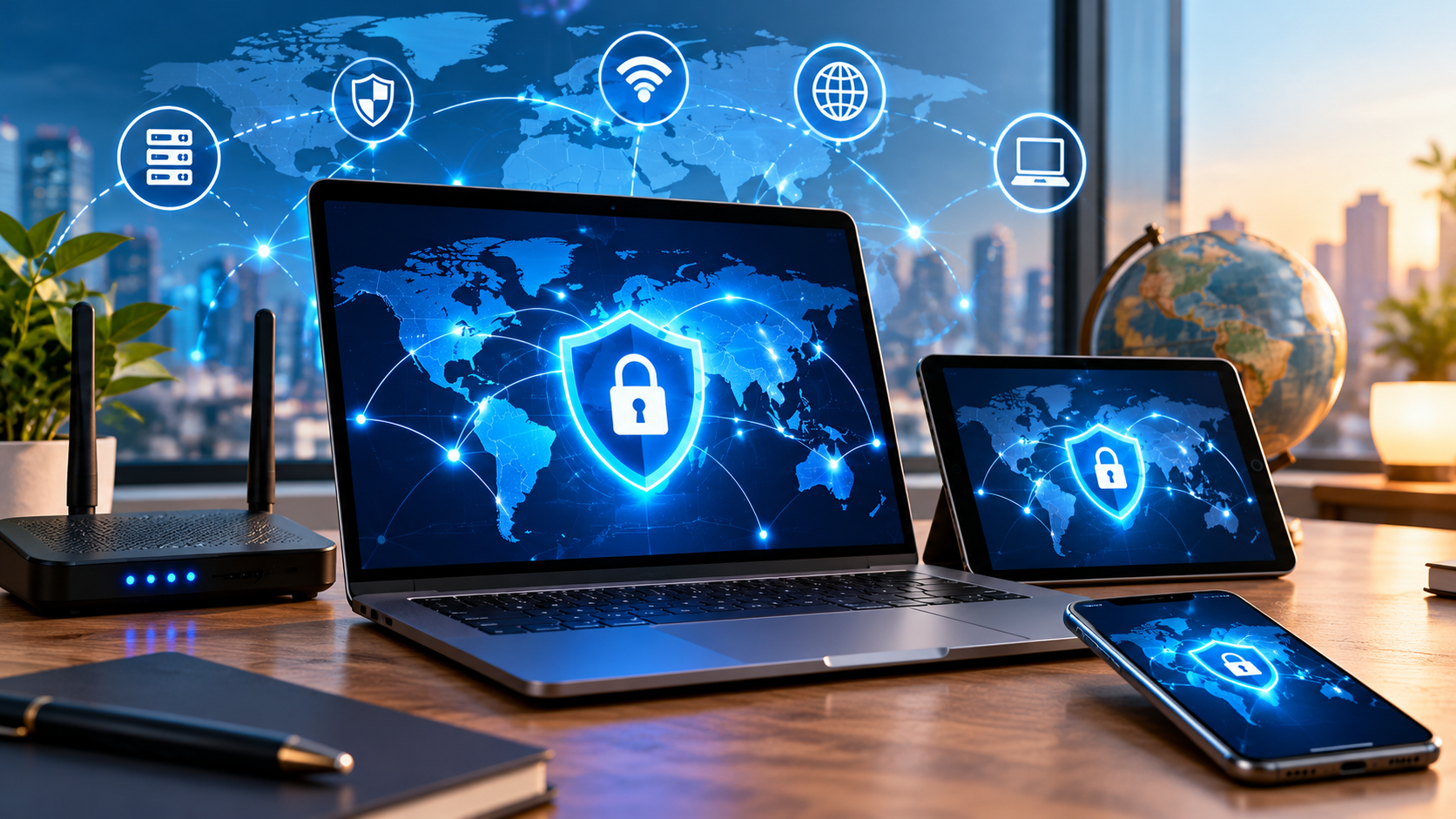
VPN technology, or Virtual Private Network technology, creates an encrypted connection between a device and a remote network or VPN server over an existing internet connection.
It helps protect data in transit, conceal a user's public IP address from destination websites, and provide secure remote access to private networks. Its protection depends on the protocol, configuration, provider, and network environment.
Modern VPN solutions are used by individuals, businesses, remote employees, and organizations that need secure network connectivity. Understanding VPN encryption, tunneling protocols, privacy policies, security features, and performance limitations helps users evaluate different VPN technologies and their practical applications.
Quick Facts About VPN Technology
Feature | Description |
|---|---|
Full Form | Virtual Private Network |
Primary Purpose | Secure communication over public or untrusted networks |
Main Technology | Encrypted network tunneling |
Common Protocols | WireGuard, OpenVPN, IKEv2/IPsec |
Encryption | Cryptographic algorithms and secure key exchange |
Main Applications | Remote access, business networking, data protection |
IP Address Function | Masks the user's public IP address from destination websites |
Security Features | Encryption, authentication, tunneling, traffic integrity |
Common Deployment Types | Remote-access VPN and site-to-site VPN |
Supported Devices | Computers, smartphones, tablets, routers, and network gateways |
Main Limitation | Does not provide complete anonymity or protect against every cyber threat |
Important Selection Factors | Protocol, security configuration, privacy policy, performance, and compatibility |
What Is VPN Technology?
A Virtual Private Network is a networking technology that establishes a protected communication path between endpoints across an existing network. It uses tunneling, authentication, and cryptographic protection to help prevent unauthorized parties from reading or modifying transmitted information.
A VPN can connect an individual device to a VPN gateway or connect two private networks through the internet. In consumer applications, traffic is commonly routed through a VPN server before reaching its destination. In enterprise environments, VPN gateways provide controlled access to internal applications, databases, and network resources.
VPN technology is not a single encryption method or application. It is a combination of networking protocols, cryptographic mechanisms, authentication systems, and routing configurations.
Why VPN Technology Matters
Internet communication frequently travels through networks that organizations and individual users do not control. Public Wi-Fi, external network providers, and internet infrastructure can create opportunities for traffic observation or unauthorized access when communication is not adequately protected.
VPN technology helps establish a secure communication channel between endpoints. This is particularly useful when employees access company resources remotely or when organizations connect geographically separated locations.
Its practical importance includes:
Data protection: Encrypts supported traffic between VPN endpoints.
Remote connectivity: Allows authorized users to access private organizational resources.
Network privacy: Helps prevent local network observers from reading protected traffic.
IP address masking: Replaces the public IP address visible to destination websites with the VPN server's address.
Secure business communication: Connects remote offices and employees to organizational networks.
Access control: Supports authentication and restrictions on private network resources.
Network management: Allows organizations to manage connectivity through centralized VPN gateways.
A VPN does not automatically protect against phishing, malware, compromised devices, or unsafe websites. It is one component of a broader cybersecurity strategy.
Understanding How VPN Technology Works
Simple Explanation
A VPN works like a protected communication tunnel between your device and a VPN server. Instead of sending supported internet traffic directly through the local network, your device sends it through an encrypted connection to the VPN endpoint.
The VPN server then forwards the traffic toward its destination. Responses travel back through the established connection, where they are protected until they reach the VPN client.
For example, when someone connects to a public Wi-Fi network using a properly configured VPN, the local network operator generally cannot read the contents of the encrypted VPN traffic. However, the VPN provider or network operator at the other end may still have visibility into certain connection information.
VPN Tunneling Technology
Tunneling is the process of encapsulating one network protocol inside another so that data can travel through an intermediary network. A VPN uses this mechanism to transport private network traffic through an existing infrastructure.
Depending on the protocol, the system may encrypt the original packet, authenticate it, and add additional headers before transmission. At the receiving endpoint, the VPN software or gateway processes the packet and forwards the original traffic toward its destination.
Encryption and Authentication
Encryption protects information against unauthorized reading, while authentication verifies the identity of communicating endpoints or users.
A secure VPN deployment uses appropriate cryptographic algorithms, authenticated key exchange, secure session establishment, and integrity protection. Encryption without proper authentication and configuration is not sufficient to establish a trustworthy VPN connection.
How VPN Technology Works Step by Step
Step 1: VPN Client Initialization
The process begins when a user opens a VPN application or connects through an operating system's built-in VPN client. The client identifies the configured VPN server, selects an available protocol, and prepares the connection.
In business environments, the VPN client may also check device certificates, user credentials, and organizational access requirements.
Step 2: Authentication and Key Exchange
The client and VPN gateway establish trust by authenticating the connection. Depending on the protocol, authentication may involve certificates, pre-shared keys, usernames, passwords, or public-key cryptography.
The endpoints also establish cryptographic session keys. These keys are used to protect subsequent communication without transmitting the private encryption keys directly across the network.
Step 3: Secure Tunnel Establishment
After successful authentication and negotiation, the VPN creates a protected tunnel between the endpoints. The tunnel may use IPsec, TLS-based protection, or another supported VPN protocol.
The connection configuration determines which traffic enters the tunnel and how network packets are transported.
Step 4: Data Encryption and Encapsulation
Outgoing traffic is processed according to the VPN protocol. The system encrypts the protected data, applies integrity protection, and encapsulates packets when required.
This prevents unauthorized network observers from easily reading or modifying the protected traffic while it travels between VPN endpoints.
Step 5: Traffic Routing Through the VPN Server
The VPN client sends protected traffic through the established tunnel. The VPN gateway processes the packets and routes permitted traffic toward the intended internal or internet destination.
For consumer VPN connections, websites generally see the VPN server's public IP address instead of the user's original public IP address.
Step 6: Response Processing
When the destination sends a response, the traffic returns through the VPN gateway or another configured network route. The VPN endpoint processes the protected packets and delivers the recovered data to the appropriate application.
Step 7: Session Termination
When the user disconnects, the VPN session is closed and its active security associations or session keys are removed according to the protocol and implementation. A properly configured system also handles unexpected disconnections to prevent unintended traffic exposure.
VPN Technology Workflow Table
Stage | Technical Process | Main Purpose |
|---|---|---|
Initialization | VPN client configuration | Identify the server and protocol |
Authentication | Credentials or certificates | Verify endpoint or user identity |
Key exchange | Cryptographic negotiation | Establish session keys |
Tunnel creation | VPN protocol initialization | Create protected connectivity |
Encryption | Data protection | Prevent unauthorized reading |
Encapsulation | Packet processing | Transport traffic through the tunnel |
Routing | VPN gateway processing | Forward permitted traffic |
Termination | Session closure | End protected communication |
VPN Architecture and Main Components
VPN Client
A VPN client is the application or operating-system component that initiates and manages a VPN connection. It handles authentication, protocol negotiation, encryption, routing, and connection status.
Consumer VPN clients usually provide server selection and connection controls. Enterprise VPN clients may also enforce device security requirements and organizational access policies.
VPN Server and Gateway
A VPN server terminates incoming VPN connections and manages communication between remote clients and permitted network destinations. It may operate as dedicated hardware, a virtual appliance, or a software-based gateway.
Business VPN gateways commonly support authentication integration, access policies, network routing, logging, and multiple simultaneous connections.
Authentication Infrastructure
Authentication infrastructure verifies users, devices, and sometimes individual services before granting access. Depending on the deployment, it may integrate with directory systems, certificate authorities, identity providers, and multi-factor authentication.
Encryption and Key Management
Cryptographic components protect data and manage session keys. Secure key exchange establishes the material needed for encryption, while authentication and integrity mechanisms help prevent unauthorized communication and packet modification.
VPN Tunneling Protocol
The tunneling protocol defines how endpoints establish connections, authenticate, exchange keys, protect packets, and maintain sessions.
Different protocols have different design characteristics, compatibility requirements, and performance behavior.
Network Routing Infrastructure
Routers, firewalls, network interfaces, and routing tables determine where VPN traffic travels. Routing configuration controls whether all traffic or only selected destinations use the tunnel.
DNS Infrastructure
Domain Name System infrastructure translates domain names into network addresses. VPN configurations may direct DNS requests through the VPN provider or organizational network to maintain consistent traffic handling.
Monitoring and Management Systems
Enterprise VPN deployments may use centralized management tools to monitor active sessions, authentication events, gateway availability, configuration changes, and security alerts.
Main VPN Components Table
Component | Primary Function | Common Application |
|---|---|---|
VPN client | Initiates and manages connections | Remote devices |
VPN server | Terminates VPN sessions | Secure network access |
VPN gateway | Routes and controls protected traffic | Enterprise networking |
Authentication system | Verifies identities | User and device access |
Cryptographic engine | Encrypts and authenticates data | Traffic protection |
Key management | Establishes and manages session keys | Secure communication |
DNS configuration | Controls domain-resolution paths | Privacy and network management |
Firewall | Enforces network access policies | Traffic filtering |
Monitoring system | Records and analyzes connection activity | Security administration |
Types of VPN Technology
VPN technologies can be classified by their deployment purpose, connection architecture, and traffic-handling approach. Remote-access VPN and site-to-site VPN are the two major deployment categories used in many organizational environments.
Remote-Access VPN
A remote-access VPN connects an individual device to a private network through an authenticated and protected tunnel. It is commonly used by employees working outside an organization's physical offices.
The connection may be established through dedicated VPN client applications or supported operating-system networking components.
Advantages:
Supports remote employee connectivity.
Provides protected access to internal applications.
Allows centralized authentication and access management.
Supports geographically distributed workforces.
Limitations:
Requires secure endpoint configuration.
Can create additional network security risks if access permissions are too broad.
Depends on reliable gateway availability.
Site-to-Site VPN
A site-to-site VPN connects two or more private networks through protected communication tunnels. VPN gateways at different locations establish the connection, allowing permitted devices to communicate across organizational networks.
It is frequently used to connect branch offices, data centers, and corporate facilities.
Advantages:
Connects geographically separated networks.
Reduces the need for dedicated private communication circuits in some deployments.
Supports centralized network connectivity.
Can provide persistent connections between locations.
Limitations:
Requires careful routing and network configuration.
Changes to network addressing can affect connectivity.
Gateway failures may interrupt communication.
Client-Based VPN
A client-based VPN uses an application or operating-system component installed on the user's device. The client establishes the tunnel and manages the connection according to configured security policies.
Advantages:
Provides control over connection settings.
Supports different authentication methods.
Can integrate with device security policies.
Limitations:
Requires installation and maintenance.
Compatibility may vary across operating systems.
Incorrect configuration can expose traffic outside the tunnel.
Clientless SSL VPN
A clientless SSL VPN provides browser-based access to selected internal resources without requiring a traditional VPN client for every supported use case.
It commonly uses HTTPS and gateway-based application access. Some implementations provide access to web applications, while others support additional resources through specific mechanisms.
Advantages:
Reduces the need for full client installation.
Supports convenient access to selected business applications.
Can limit access to particular resources.
Limitations:
May not support every application or network protocol.
Depends on gateway capabilities.
Browser-based access still requires strong authentication and security controls.
Full-Tunnel VPN
A full-tunnel VPN routes all configured internet traffic through the VPN connection. This approach allows centralized traffic inspection and policy enforcement in organizational environments.
Advantages:
Centralizes supported network traffic.
Helps organizations apply consistent security policies.
Reduces reliance on direct local internet routing.
Limitations:
May increase bandwidth demand at the VPN gateway.
Can introduce additional network latency.
Requires sufficient gateway capacity.
Split-Tunnel VPN
A split-tunnel VPN routes only selected traffic through the VPN while allowing other traffic to use the device's normal internet connection.
For example, an employee may access internal company applications through the VPN while general internet browsing uses the local network.
Advantages:
Reduces unnecessary traffic through corporate gateways.
Can improve access to public internet resources.
Helps manage enterprise bandwidth requirements.
Limitations:
Requires careful routing and security configuration.
Can introduce additional network exposure.
May complicate DNS and IP address privacy management.
VPN Technology Type Comparison
VPN Type | Connection Structure | Primary Use | Main Consideration |
|---|---|---|---|
Remote-access VPN | Individual device to private network | Remote employees | Endpoint security |
Site-to-site VPN | Network gateway to network gateway | Branch connectivity | Routing and gateway configuration |
Client-based VPN | Installed client to VPN gateway | Personal and enterprise access | Client maintenance |
Clientless SSL VPN | Browser to secure gateway | Selected application access | Application compatibility |
Full-tunnel VPN | All configured traffic through tunnel | Centralized traffic management | Bandwidth and latency |
Split-tunnel VPN | Selected traffic through tunnel | Flexible network routing | Traffic exposure and policy control |
These classifications are not mutually exclusive. For example, an organization can use a client-based remote-access VPN with full-tunnel routing.
VPN Protocols and Encryption Technologies
VPN protocols determine how protected connections are created, authenticated, and maintained. Selecting an appropriate VPN protocol is an important part of VPN security and performance planning.
WireGuard
WireGuard is a modern VPN protocol designed around a relatively compact codebase and a defined set of cryptographic mechanisms. It uses public-key cryptography for peer authentication and key establishment, with ChaCha20-Poly1305 for authenticated encryption.
Its design also uses Curve25519 for key exchange and BLAKE2s for hashing-related functions.
Advantages:
Relatively simple protocol design.
Modern cryptographic construction.
Efficient operation on supported platforms.
Suitable for many personal and enterprise VPN deployments.
Limitations:
Requires appropriate key and peer management.
Network roaming and deployment behavior depend on implementation.
Enterprise identity integration may require additional infrastructure.
OpenVPN
OpenVPN is an open-source VPN solution that uses TLS-based mechanisms for control-channel security and negotiated cryptographic protection for data traffic. It supports both UDP and TCP transport configurations.
It is widely used in personal and enterprise environments because of its flexibility and platform compatibility.
Advantages:
Flexible configuration options.
Supports certificate-based authentication.
Broad operating-system compatibility.
Extensive deployment experience.
Limitations:
Configuration can be complex.
Performance depends on encryption settings, transport, and implementation.
TCP-based tunneling may introduce additional performance problems in certain network conditions.
Internet Protocol Security
Internet Protocol Security, or IPsec, is a suite of protocols that provides security at the IP network layer. It supports authentication, integrity protection, encryption, and replay protection through appropriate configurations.
IPsec is commonly used in site-to-site VPNs and enterprise remote-access architectures.
Advantages:
Supports network-to-network connectivity.
Provides standardized security mechanisms.
Integrates with many enterprise networking platforms.
Can protect traffic independently of individual applications.
Limitations:
Configuration and troubleshooting can be complex.
Network address translation may require additional handling.
Interoperability depends on compatible configuration parameters.
Internet Key Exchange Version 2
IKEv2 is a key-management protocol used with IPsec. It establishes and manages security associations, negotiates cryptographic parameters, and supports authentication between VPN endpoints.
IKEv2 is often deployed with IPsec as an integrated VPN solution.
Advantages:
Supports reliable connection establishment.
Provides structured security negotiation.
Supports mobility and multihoming through MOBIKE extensions.
Commonly supported in enterprise networking environments.
Limitations:
Requires correct IPsec configuration.
Firewall and network restrictions can interfere with connectivity.
Implementation compatibility must be considered.
SSL/TLS-Based VPN
SSL/TLS-based VPN solutions use Transport Layer Security to protect communication between a client and a gateway. They may provide browser-based application access or full network connectivity, depending on the implementation.
TLS-based VPN deployments are often used for remote-access applications and controlled enterprise connectivity.
Advantages:
Uses widely supported TLS security mechanisms.
Can support browser-based access.
Offers flexible application-level connectivity.
Limitations:
Gateway configuration and authentication remain critical.
Different implementations support different access methods.
Vulnerabilities in exposed gateways can create significant security risks.
Legacy VPN Protocols
Older VPN technologies such as PPTP and configurations relying on outdated cryptographic algorithms should not be selected for new security-sensitive deployments. Legacy protocols may remain in older systems for compatibility, but they require careful risk evaluation and migration planning.
L2TP without IPsec does not provide the same encryption protection as a properly configured secure VPN. Where L2TP/IPsec is used, both components must be configured appropriately.
VPN Protocol Comparison Table
VPN Protocol | Security Approach | Common Transport | Main Strength | Key Consideration |
|---|---|---|---|---|
WireGuard | Modern public-key cryptography and authenticated encryption | UDP | Compact design and efficient operation | Peer and key management |
OpenVPN | TLS-based control channel and encrypted data channel | UDP or TCP | Flexibility and compatibility | Configuration complexity |
IPsec | Network-layer encryption and integrity protection | IP protocols and UDP encapsulation where required | Enterprise network connectivity | Configuration and interoperability |
IKEv2/IPsec | IKEv2 key management with IPsec protection | Commonly UDP | Connection management and mobility support | Requires compatible implementations |
SSL/TLS VPN | TLS-protected communication | TCP | Browser and application access options | Gateway security and implementation differences |
PPTP | Legacy tunneling and outdated security mechanisms | TCP and GRE | Historical compatibility | Not suitable for modern secure deployments |
Important distinction: IPsec is a security architecture and protocol suite, while IKEv2 is a key-management protocol used to establish IPsec security associations. WireGuard and OpenVPN are separate VPN protocol implementations.
VPN Encryption and Security Requirements
Advanced Encryption Standard
Advanced Encryption Standard (AES) is a symmetric encryption algorithm widely used in network security. AES supports different key lengths, including 128-bit, 192-bit, and 256-bit configurations.
VPN implementations may use AES-GCM, which combines encryption with authentication and integrity protection. AES-GCM is commonly used in modern OpenVPN and IPsec configurations.
ChaCha20-Poly1305
ChaCha20-Poly1305 combines the ChaCha20 stream cipher with the Poly1305 authentication mechanism. It provides authenticated encryption and is used by WireGuard and other modern secure communication implementations.
Its performance characteristics can be useful on devices without specialized hardware acceleration for AES.
Public-Key Cryptography
Public-key cryptography uses mathematically related public and private keys. It supports authentication and secure key establishment without requiring private keys to be transmitted over the network.
VPN protocols use public-key mechanisms in different ways to authenticate endpoints and establish session keys.
Secure Key Exchange
Key exchange allows VPN endpoints to establish shared cryptographic secrets. Protocols such as IKEv2 use structured negotiation procedures to establish security associations and derive session keys.
Secure key management is essential because weak authentication, exposed private keys, or poor configuration can undermine otherwise strong encryption.
Multi-Factor Authentication
Multi-factor authentication (MFA) requires users to provide additional verification beyond a password. Common methods include authenticator applications, hardware security keys, and other approved authentication mechanisms.
Enterprise VPN deployments should use MFA, particularly for privileged accounts and remote access to sensitive systems.
Forward Secrecy
Perfect forward secrecy is a security property that helps protect previously established sessions if long-term private keys are compromised later. It is supported by appropriate ephemeral key-exchange mechanisms.
Forward secrecy reduces the consequences of certain key compromises, but it does not protect information that was already exposed at an endpoint.
VPN vs Proxy vs Zero Trust Network Access
VPNs, proxy servers, and Zero Trust Network Access (ZTNA) can all influence how users connect to network resources, but they operate differently.
A VPN generally establishes a protected network tunnel, while a proxy forwards requests on behalf of a client or application. ZTNA focuses on granting access to specific resources after evaluating identity, device, and contextual security requirements.
Feature | VPN | Proxy Server | ZTNA |
|---|---|---|---|
Primary Purpose | Protected network connectivity | Request forwarding | Controlled application access |
Connection Model | Encrypted tunnel | Intermediary request handling | Identity-based access |
Network Access | Can provide broad network access | Usually application or traffic specific | Limited to authorized resources |
Encryption | Provided by secure VPN protocols | Depends on proxy configuration and underlying transport | Uses protected communication channels |
Authentication | Credentials, certificates, MFA | Varies by implementation | Identity and contextual verification |
Common Application | Remote network access | Web traffic management | Enterprise application access |
Main Limitation | Broad access can increase exposure | Does not automatically encrypt all traffic | Requires identity and policy infrastructure |
A VPN and ZTNA are not necessarily competing technologies. Organizations may use both, depending on application requirements, network architecture, and security policies.
Benefits and Advantages of VPN Technology
Encrypted Internet Communication
A properly configured VPN protects supported traffic between the device and VPN endpoint. This reduces the ability of local network observers to inspect the contents of that communication.
Secure Remote Network Access
Remote-access VPN solutions allow authorized employees to connect to internal business applications, file systems, and other organizational resources without being physically present at the office.
Public IP Address Masking
When internet traffic is routed through a VPN server, destination websites generally see the server's public IP address rather than the original public IP address of the user.
This can reduce direct exposure of the user's network address to destination websites, although it does not make the user anonymous.
Business Network Connectivity
Site-to-site VPN connections allow organizations to establish protected communication between geographically separated offices and data centers.
Centralized Security Management
Enterprise VPN gateways can integrate authentication, access restrictions, traffic policies, and connection monitoring into a centralized network security architecture.
Protection on Public Wi-Fi
VPN encryption can protect supported traffic from local network observers when users connect through shared or untrusted wireless networks. It does not eliminate risks from malicious access points, compromised devices, or fraudulent websites.
Flexible Network Deployment
VPN technology supports software-based, hardware-based, cloud-hosted, and hybrid network architectures. Organizations can select an implementation according to their infrastructure and connectivity requirements.
Industry Applications of VPN Technology
Enterprise and Corporate Networking
Businesses use enterprise VPN solutions to provide remote employees with protected access to internal applications, databases, and corporate resources.
Organizations may combine VPN gateways with identity management, MFA, endpoint security, and network segmentation to control access.
Banking and Financial Institutions
Financial organizations use protected network connections to support communication between branches, data centers, and authorized remote users.
VPN technology can protect data in transit, but it must be combined with transaction security, identity verification, access monitoring, and other financial security controls.
Healthcare Organizations
Hospitals, clinics, laboratories, and healthcare networks may use VPN connectivity to support authorized remote access to internal systems and administrative applications.
Healthcare deployments must also consider patient-data confidentiality, access controls, audit requirements, and applicable privacy regulations.
Education and Research
Universities and research institutions use VPN connections to provide authorized users with access to internal libraries, research infrastructure, academic databases, and laboratory resources.
Cloud Computing and Data Centers
Organizations use VPN gateways to connect private infrastructure with cloud networks, remote offices, and administrative systems. These connections can support controlled communication between distributed computing environments.
IT and Managed Network Operations
IT teams use VPN connectivity for authorized remote administration, infrastructure monitoring, and troubleshooting. Administrative VPN access should be restricted and protected through strong authentication and logging.
Industry Applications of VPN Technology Table
Industry | VPN Application | Main Security Requirement |
|---|---|---|
Corporate businesses | Remote employee access | Identity and device verification |
Banking | Branch and data center connectivity | Strong authentication and monitoring |
Healthcare | Authorized access to internal systems | Patient-data protection |
Education | Research and academic network access | User access management |
Cloud computing | Private network connectivity | Network segmentation |
IT operations | Remote infrastructure administration | Privileged access protection |
Manufacturing | Secure access to industrial networks | Restricted remote connectivity |
Telecommunications | Protected network administration | Gateway security and traffic control |
VPN Standards and Security Frameworks
VPN security depends on established networking standards, cryptographic specifications, and organizational security practices. The following standards and frameworks are relevant to modern VPN architecture.
IETF RFC 4301: Security Architecture for the Internet Protocol
RFC 4301 defines the architecture for IPsec. It describes security associations, traffic processing, access control, and the security services provided through IPsec mechanisms.
IETF RFC 7296: Internet Key Exchange Protocol Version 2
RFC 7296 specifies IKEv2, which establishes and manages security associations for IPsec communication. It defines authentication, negotiation, and key-management procedures.
IETF RFC 8446: The Transport Layer Security Protocol Version 1.3
RFC 8446 specifies TLS 1.3, a protocol that provides authenticated and encrypted communication. TLS 1.3 is relevant to VPN implementations that use TLS for protected connections.
NIST SP 800-77: Guide to IPsec VPNs
NIST SP 800-77 provides guidance on IPsec VPN technologies, their deployment, and security considerations. It is relevant to organizations evaluating IPsec-based network protection.
NIST SP 800-207: Zero Trust Architecture
NIST SP 800-207 describes the principles of Zero Trust Architecture. It is not a VPN protocol standard, but its identity-based and resource-focused access principles are relevant when integrating VPN technology into modern enterprise security environments.
ISO/IEC 27001
ISO/IEC 27001 specifies requirements for establishing, implementing, maintaining, and continually improving an information security management system. It can support organizational governance of VPN security, access management, and risk controls.
Common VPN Security Challenges and Solutions
Challenge | Possible Cause | Recommended Security Measure |
|---|---|---|
DNS leaks | DNS requests bypass the VPN tunnel | Configure protected DNS routing |
IP address leaks | Incorrect routing or connection failure | Enable leak protection and verify routing |
Weak authentication | Password-only access or compromised credentials | Implement MFA and strong authentication |
Outdated VPN protocols | Legacy cryptographic configurations | Migrate to modern, supported protocols |
VPN gateway vulnerabilities | Unpatched or exposed network infrastructure | Apply security updates promptly |
Slow connection speeds | Server distance, congestion, or encryption overhead | Evaluate gateway capacity and network paths |
Incorrect split tunneling | Inadequate routing policies | Review permitted traffic destinations |
Unauthorized access | Excessive user permissions | Apply least-privilege access controls |
Session hijacking | Weak session management or compromised endpoints | Use secure authentication and session controls |
Configuration errors | Incorrect encryption, routing, or firewall settings | Conduct regular configuration reviews |
Device compromise | Malware or insecure endpoint environments | Implement endpoint protection and device verification |
Service interruptions | Gateway or network failures | Establish redundancy and recovery procedures |
DNS Leaks
A DNS leak occurs when domain-name requests travel outside the intended VPN-protected route. This may expose browsing-related information to the local network or another DNS provider.
Appropriate DNS routing, leak protection, and configuration testing help reduce this risk.
IP Address Leaks
An IP leak can occur when traffic bypasses the VPN tunnel or when certain network interfaces remain active outside the protected connection.
IPv4, IPv6, and WebRTC-related behavior should be considered when evaluating VPN privacy. A correctly configured VPN should handle supported network traffic consistently.
VPN Gateway Vulnerabilities
VPN gateways are internet-facing infrastructure in many deployments, making them important security targets. Vulnerable firmware, outdated components, exposed management interfaces, and compromised credentials can provide attackers with opportunities to gain unauthorized access.
Organizations should maintain supported versions, apply security patches, monitor authentication activity, and restrict administrative access.
Weak Access Controls
A VPN connection does not automatically mean that a user should have access to every internal system. Excessive permissions can increase the impact of compromised accounts or devices.
Role-based access control, network segmentation, MFA, and least-privilege policies help reduce unnecessary exposure.
Performance and Latency Problems
VPN connections may become slower because of server distance, network congestion, encryption processing, routing inefficiencies, or insufficient gateway capacity.
Performance evaluation should consider actual application requirements rather than relying only on advertised connection speeds.
How to Choose a VPN Solution
Selecting a VPN solution requires understanding whether the primary requirement is personal internet privacy, secure business networking, remote employee access, or site-to-site connectivity.
A consumer VPN subscription and an enterprise VPN gateway serve different purposes. The correct choice depends on security requirements, technical infrastructure, authentication methods, and the type of traffic being protected.
Selection Factor | What to Evaluate | Why It Matters |
|---|---|---|
Primary purpose | Personal privacy, remote access, or business networking | Determines the appropriate VPN architecture |
Protocol support | WireGuard, OpenVPN, IKEv2/IPsec, or other supported protocols | Influences security and compatibility |
Encryption | Modern authenticated encryption configurations | Protects data in transit |
Authentication | MFA, certificates, and identity integration | Reduces unauthorized access |
Privacy policy | Logging, data retention, and sharing practices | Helps evaluate provider privacy |
Server infrastructure | Location, capacity, and network reliability | Influences connectivity and performance |
Device compatibility | Windows, macOS, Linux, Android, iOS, and routers | Ensures deployment compatibility |
DNS protection | Secure DNS handling and leak protection | Reduces unintended information exposure |
Kill switch | Traffic blocking during unexpected VPN disconnection | Helps prevent accidental direct routing |
Split tunneling | Ability to control which traffic uses the tunnel | Supports network flexibility |
Security management | Monitoring, patching, and access policies | Supports ongoing protection |
Scalability | User capacity and gateway expansion | Supports future organizational requirements |
Technical support | Documentation and maintenance assistance | Helps manage configuration and operational issues |
Choosing a VPN for Personal Use
Individuals should prioritize supported modern protocols, clear privacy policies, reliable applications, DNS leak protection, and transparent information about data retention.
A provider's claim of a no-logs policy should be evaluated carefully. Users should understand which connection records, diagnostic information, or account details may still be collected.
Choosing an Enterprise VPN Solution
Businesses should evaluate centralized management, identity-provider integration, MFA, network segmentation, logging, gateway redundancy, and compatibility with existing infrastructure.
For sensitive environments, VPN connectivity should be integrated into a wider security architecture rather than treated as the only access-control mechanism.
Choosing a VPN for Site-to-Site Networking
Organizations connecting multiple locations should consider IPsec support, routing compatibility, gateway capacity, redundancy, and network address planning.
The design should also account for overlapping IP ranges, failover behavior, and the security requirements of each connected network.
VPN Maintenance and Security Best Practices
Keep VPN Infrastructure Updated
VPN applications, gateway firmware, operating systems, and associated network components should receive security updates according to a documented maintenance process.
Internet-facing VPN gateways require particular attention because vulnerabilities in remote-access infrastructure can expose internal networks.
Use Multi-Factor Authentication
MFA adds another verification requirement beyond passwords. It is particularly important for administrator accounts, remote employees, and users accessing sensitive organizational systems.
Review VPN Access Permissions
Organizations should regularly examine user accounts, device permissions, and network access policies. Accounts that are no longer required should be disabled through established access-management procedures.
Monitor VPN Connection Logs
Connection logs can help identify unusual authentication attempts, unexpected locations, repeated failures, and suspicious access patterns.
Logging should be proportionate to security needs and applicable privacy requirements.
Test DNS and IP Leak Protection
VPN administrators and users should verify that traffic follows the intended routing configuration. Testing should consider IPv4, IPv6, DNS handling, and unexpected connection interruptions.
Configure Kill Switch Protection
A VPN kill switch blocks specified network traffic when the protected connection unexpectedly disconnects. This feature can reduce accidental exposure, but its behavior depends on the operating system and application configuration.
Review Split-Tunneling Policies
Split tunneling should be configured according to clear business requirements. Organizations should determine which destinations are permitted outside the VPN and evaluate the security implications.
Maintain Secure Encryption Settings
Administrators should use currently supported cryptographic configurations and remove obsolete algorithms or insecure protocol options. Security settings should be reviewed whenever infrastructure or protocol implementations change.
Establish Gateway Redundancy
Critical business environments may use multiple VPN gateways or failover arrangements to reduce dependence on a single connection endpoint.
Redundancy should be tested periodically to confirm that recovery procedures work as intended.
Limitations of VPN Technology
VPN technology improves communication security, but it does not make every internet activity private or eliminate all cybersecurity risks.
VPN Providers Can Still Have Network Visibility
A consumer VPN provider becomes an important intermediary for traffic routed through its infrastructure. Depending on the configuration and application, it may have access to connection metadata, DNS activity, and destination-related information.
Encryption between the device and VPN server does not mean that the provider cannot observe any information.
VPNs Do Not Guarantee Complete Anonymity
Websites can still identify users through account logins, browser fingerprinting, cookies, and other tracking mechanisms. A masked public IP address does not eliminate these identification methods.
Encryption Ends at the VPN Endpoint
In a typical consumer VPN arrangement, traffic is protected between the user's device and the VPN server. Beyond that endpoint, the security of the connection depends on the destination protocol and network.
HTTPS provides additional encryption between the browser and the destination website.
Performance Can Be Reduced
Encryption, additional routing, server congestion, and physical distance can affect connection speed and latency. The impact varies according to network conditions and the VPN implementation.
Misconfiguration Can Weaken Security
Incorrect routing, outdated encryption settings, weak authentication, or DNS leaks can undermine the intended protection.
Enterprise deployments require careful configuration and ongoing security reviews.
VPNs Do Not Replace Endpoint Security
A VPN cannot automatically detect malware, prevent phishing, secure compromised devices, or stop an authorized user from misusing access privileges.
Firewalls, endpoint protection, MFA, network segmentation, and security monitoring remain important.
Enterprise VPNs Can Create Broad Access Risks
Traditional network-level VPN access may allow a connected device to reach more internal resources than necessary. If that device becomes compromised, the potential impact can extend beyond the original user.
Organizations should restrict access and consider application-level controls where appropriate.
Future Trends in VPN Technology for 2026 and Beyond
Zero Trust Network Integration
Enterprise VPN deployments are increasingly evaluated alongside Zero Trust Network Access architectures. Instead of relying only on network location, organizations can combine identity verification, device posture, and resource-specific authorization.
This approach helps reduce excessive access to internal systems.
Modern Cryptographic Implementations
VPN development continues to emphasize modern authenticated encryption, secure key exchange, and efficient cryptographic implementations. Protocol maintenance and migration away from obsolete algorithms remain important security priorities.
Post-Quantum Cryptography Considerations
Advances in quantum computing research have increased attention to cryptographic systems that may be vulnerable to future quantum attacks.
Organizations are evaluating post-quantum cryptography standards and migration strategies. However, a standard VPN protocol should not automatically be described as post-quantum secure merely because it uses modern encryption.
Cloud-Based VPN Gateways
Cloud-hosted VPN infrastructure allows organizations to establish protected connections between remote employees, cloud environments, and private networks.
Deployment decisions increasingly involve scalability, network segmentation, identity integration, and the location of sensitive data.
Improved Network Performance
Modern VPN implementations are focusing on efficient packet processing, better connection management, and improved operation across different network environments.
Hardware acceleration, optimized cryptographic implementations, and modern protocols can help improve performance under suitable conditions.
Stronger Gateway Security
Internet-facing VPN infrastructure remains an important target for cyberattacks. Future deployments will continue to emphasize rapid patching, MFA, restricted management access, security monitoring, and reduced attack surfaces.
Frequently Asked Questions About VPN Technology
1. What is VPN technology and how does it work?
VPN technology creates an encrypted connection between a device and a remote VPN server or network gateway. It uses tunneling, authentication, and cryptographic protection to secure supported data while it travels across an existing network.
2. Which VPN protocol is the most secure?
WireGuard, OpenVPN, and properly configured IKEv2/IPsec are widely used modern VPN technologies. Security depends on the cryptographic configuration, authentication methods, implementation quality, and ongoing maintenance rather than the protocol name alone.
3. What is the difference between WireGuard and OpenVPN?
WireGuard uses a relatively compact protocol design and a defined set of modern cryptographic mechanisms. OpenVPN uses TLS-based security and offers extensive configuration flexibility. Both can provide strong protection when correctly implemented.
4. Does a VPN hide your IP address?
A VPN generally replaces the public IP address visible to destination websites with the VPN server's public IP address. However, websites may still identify users through account information, cookies, browser fingerprinting, and other tracking methods.
5. What is the difference between a remote-access VPN and a site-to-site VPN?
A remote-access VPN connects an individual device to a private network. A site-to-site VPN connects separate networks through VPN gateways, allowing authorized communication between different offices or data centers.
6. Is VPN encryption enough to protect internet privacy?
No. VPN encryption protects supported traffic between the device and VPN endpoint, but it does not prevent every form of tracking, phishing, malware, or account compromise. HTTPS, secure devices, strong authentication, and responsible browsing practices provide additional protection.
7. What is split tunneling in VPN technology?
Split tunneling allows selected traffic to travel through a VPN while other traffic uses the regular internet connection. It can improve network efficiency, but incorrect configuration may expose traffic that should remain protected.
8. What is a VPN kill switch?
A VPN kill switch blocks specified network traffic when the VPN connection unexpectedly disconnects. It helps prevent traffic from accidentally switching to an unprotected connection, although its effectiveness depends on implementation and configuration.
9. Can businesses use VPN technology for remote employees?
Yes. Enterprise remote-access VPN solutions allow authorized employees to connect to internal applications and private network resources. Businesses commonly combine VPN connectivity with MFA, endpoint security, network segmentation, and centralized monitoring.
10. Are VPNs still necessary with Zero Trust security?
VPNs remain useful for many network connectivity requirements, including remote access and site-to-site communication. Zero Trust provides an additional security approach focused on identity, device verification, and resource-level authorization, and organizations may use both technologies together.
Conclusion
VPN technology provides encrypted network connectivity through tunneling, authentication, and cryptographic protection. Protocols such as WireGuard, OpenVPN, and IKEv2/IPsec support different personal and enterprise networking requirements, while remote-access and site-to-site architectures address different connectivity needs.
In 2026, effective VPN security requires more than selecting an encryption protocol. Strong authentication, updated gateways, secure routing, DNS protection, access restrictions, and continuous monitoring are equally important. Understanding these technologies and their limitations helps individuals and organizations make informed decisions about VPN security, privacy, and network infrastructure.