Explore industrial sensors, including their working principles, components, types, applications, recent developments and important selection factors.
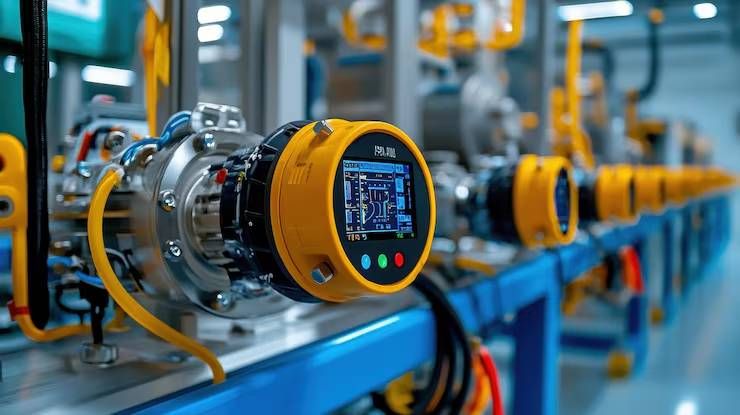
Industrial sensors are essential components of modern manufacturing, automation, and industrial monitoring systems. They are electronic or electromechanical devices that detect changes in physical conditions, such as temperature, pressure, movement, distance, humidity, vibration, and liquid levels. These devices convert information from the surrounding environment into signals that machines and control systems can interpret.
Context
Industrial sensors are essential components of modern manufacturing, automation, and industrial monitoring systems. They are electronic or electromechanical devices that detect changes in physical conditions, such as temperature, pressure, movement, distance, humidity, vibration, and liquid levels. These devices convert information from the surrounding environment into signals that machines and control systems can interpret.
The development of industrial sensors is closely connected to the growth of industrial automation. Earlier manufacturing processes depended heavily on manual inspection and mechanical measurement instruments. As factories introduced automated production lines, the need for continuous monitoring and accurate measurement increased. Sensors gradually became important parts of programmable logic controllers (PLCs), industrial robots, and automated equipment.
Today, industrial sensor technology is used across manufacturing facilities, power plants, warehouses, chemical processing facilities, agricultural systems, and transportation infrastructure. These devices help machines recognize their operating conditions and provide information that supports automated decisions.
How Industrial Sensors Work
An industrial sensor works by detecting a physical change and converting it into a measurable electrical or digital signal. The exact working principle depends on the type of sensor and the physical property being measured.
For example, a temperature sensor detects changes in heat, while a proximity sensor identifies the presence of an object without necessarily touching it. The collected information can be transmitted to a controller, monitoring platform, or computer system.
A typical measurement process involves three stages:
Detection: The sensing element identifies a physical change, such as movement, pressure, or temperature.
Signal conversion: The sensor converts the detected condition into an electrical signal or digital information.
Data transmission: The information is sent to a PLC, control unit, display, or industrial monitoring system for further processing.
Some sensors operate independently, while others are connected to larger industrial Internet of Things (IIoT) networks.
Main Components of Industrial Sensors
Although sensor designs vary, many industrial sensors contain several common components.
Sensing element: Detects the physical condition being measured.
Transducer: Converts the detected physical quantity into an electrical signal.
Signal conditioning circuit: Adjusts the signal to make it suitable for measurement or processing.
Processing unit: Interprets the signal and may perform calculations or apply measurement corrections.
Communication interface: Transfers information to external equipment through wired or wireless connections.
Housing and protection: Protects internal components against dust, moisture, vibration, temperature changes, and other environmental conditions.
Importance
Industrial sensors play an important role in modern production because they provide information about machines, materials, and surrounding conditions. Without reliable measurement systems, automated equipment may have difficulty identifying changes that affect production quality, operational stability, and workplace safety.
Their importance extends beyond manufacturing facilities. Water treatment plants, electricity networks, food processing units, transportation systems, and agricultural operations also depend on accurate monitoring.
Industrial Automation and Process Monitoring
Automated production lines use sensors to monitor the movement of materials, identify objects, measure operating conditions, and coordinate machine activities. For example, a photoelectric sensor can detect products moving along a conveyor belt and send a signal to the control system.
Temperature and pressure sensors also help monitor industrial processes where operating conditions must remain within defined limits.
Equipment Maintenance and Reliability
Machine components gradually experience wear, vibration, temperature changes, and mechanical stress. Industrial condition monitoring sensors collect information that can help maintenance teams recognize unusual operating patterns.
Vibration sensors, for instance, can identify changes in rotating equipment, including motors, pumps, and compressors. This information can support predictive maintenance planning and help identify potential mechanical problems.
Product Quality and Workplace Safety
Industrial sensors support quality inspection by measuring dimensions, detecting surface defects, and checking whether products meet specified manufacturing requirements.
They also contribute to workplace safety through gas detection, temperature monitoring, pressure measurement, and machine position monitoring. However, safety-related applications require suitable equipment, system design, and testing rather than relying on an ordinary sensor alone.
Common Types of Industrial Sensors
Different industrial applications require different sensing technologies.
| Sensor Type | Working Principle | Common Applications |
|---|---|---|
| Temperature sensor | Measures thermal changes | Furnaces, motors, cooling systems |
| Pressure sensor | Detects pressure variations | Pumps, pipelines, compressors |
| Proximity sensor | Detects nearby objects | Robotics, conveyor systems |
| Photoelectric sensor | Uses light to detect objects | Packaging, product counting |
| Ultrasonic sensor | Uses reflected sound waves | Distance and liquid-level measurement |
| Vibration sensor | Measures mechanical vibrations | Motors, turbines, pumps |
| Flow sensor | Measures fluid movement | Water systems, chemical processing |
| Humidity sensor | Measures moisture in air | Storage, food processing |
| Level sensor | Detects material or liquid levels | Tanks, silos, reservoirs |
Each technology has different measurement ranges, environmental limitations, and installation requirements. Selecting an appropriate type depends on the physical condition being monitored and the surrounding operating environment.
Recent Updates
Industrial sensor technology continues to develop alongside smart manufacturing, connected machinery, artificial intelligence, and industrial IoT systems. Recent developments from 2024 to 2026 show increasing interest in connected monitoring, edge computing, wireless communication, and intelligent data processing.
Smart Sensors and Edge Computing
Traditional sensors mainly transmit measurement signals to external controllers. Smart sensors can include additional processing capabilities that allow them to evaluate information, identify abnormal conditions, and communicate diagnostic details.
Edge computing is another developing area. Instead of sending every measurement to a remote computer or cloud platform, connected devices can process selected information near the machinery. This approach can reduce communication requirements and support quicker responses in applications that require timely monitoring.
Wireless Industrial Sensor Networks
Wireless industrial sensors are gaining attention because they can monitor equipment in locations where installing communication cables may be difficult. Technologies such as Bluetooth Low Energy, industrial Wi-Fi, and private 5G support different connectivity requirements.
However, wireless systems must account for interference, signal coverage, power consumption, and communication reliability, particularly in facilities containing heavy machinery and metal structures.
AI-Based Condition Monitoring
Artificial intelligence and machine learning are increasingly being integrated into industrial monitoring platforms. These technologies can analyze information collected from temperature, pressure, vibration, and other sensors to identify patterns associated with equipment conditions.
AI-based predictive maintenance systems can help identify unusual changes and support maintenance planning. Their accuracy depends on data quality, suitable training information, system configuration, and ongoing evaluation.
Digital Twins and Connected Manufacturing
Digital twin technology creates a digital representation of a physical machine, production process, or industrial facility. Industrial sensors provide measurement data that helps keep these representations connected with actual operating conditions.
The combination of sensor networks, automation software, and digital twins supports equipment monitoring, process analysis, and production planning.
Laws or Policies
In India, industrial sensors and related equipment are influenced by product standards, electrical safety requirements, workplace regulations, and industrial automation guidelines. The exact requirements depend on the sensor's design, intended application, operating environment, and whether it forms part of a regulated product or safety system.
Bureau of Indian Standards
The Bureau of Indian Standards (BIS) develops Indian Standards covering product quality, safety, measurement, and technical requirements. The BIS Act, 2016 provides the legal framework for standardization and product certification.
BIS certification is generally voluntary unless a particular product is covered by a compulsory certification requirement or a relevant Quality Control Order. Therefore, not every industrial sensor automatically requires BIS certification. Manufacturers and organizations must check the applicable product category and current government notifications.
Electrical and Industrial Safety
Industrial sensor installations must consider relevant electrical safety requirements, equipment protection, and workplace safety rules. Sensors used in hazardous locations may require additional protection and appropriate certification according to the applicable standards.
Industries should also consider electromagnetic compatibility (EMC), electrical isolation, grounding, and protection against environmental conditions when installing electronic monitoring equipment.
Industrial Communication and Cybersecurity
Connected industrial sensors exchange information with controllers, computers, and monitoring networks. Their communication systems should be configured to reduce unauthorized access and protect operational information.
International standards such as the IEC 62443 series provide guidance on cybersecurity for industrial automation and control systems. These standards are relevant when designing secure connected manufacturing environments.
Tools and Resources
Several technical tools and information platforms help users understand industrial sensors, evaluate specifications, and plan monitoring systems.
Sensor Selection and Measurement Tools
Sensor datasheets: Provide measurement ranges, accuracy, operating temperature, electrical requirements, and installation information.
Measurement unit converters: Help convert pressure, temperature, distance, and flow measurements between different units.
Calibration equipment: Supports checking sensor accuracy against recognized measurement references.
PLC simulation software: Helps users understand how sensor signals interact with industrial control logic.
Industrial communication analyzers: Assist in examining data transmission and communication performance.
Technical Websites and Standards Resources
Bureau of Indian Standards (BIS): Provides information about Indian Standards and product certification requirements.
International Electrotechnical Commission (IEC): Publishes international standards covering electrical equipment, measurement, and industrial automation.
International Society of Automation (ISA): Provides educational material about instrumentation, process control, and industrial automation.
IO-Link: Provides technical information about standardized communication between industrial sensors, actuators, and control systems.
National Institute of Standards and Technology (NIST): Provides measurement science resources, technical publications, and information about industrial technologies.
These resources help readers understand sensor specifications, measurement principles, communication technologies, and relevant technical requirements.
FAQs
What Are Industrial Sensors Used For?
Industrial sensors measure physical conditions such as temperature, pressure, movement, vibration, humidity, and liquid levels. They are commonly used in manufacturing, process control, machine monitoring, robotics, and industrial safety systems.
What Are the Main Types of Industrial Sensors?
Common types include temperature sensors, pressure sensors, proximity sensors, photoelectric sensors, ultrasonic sensors, vibration sensors, flow sensors, humidity sensors, and level sensors. Each type detects a different physical condition.
How Do Industrial Sensors Work in Automation Systems?
Industrial sensors detect changes in their surroundings and convert them into electrical or digital signals. These signals are transmitted to PLCs or other controllers, which process the information and coordinate machine operations.
What Factors Should Be Considered When Selecting Industrial Sensors?
Important selection factors include measurement range, accuracy, response time, operating temperature, environmental protection, installation requirements, communication compatibility, and maintenance needs. The application and surrounding conditions determine which specifications are appropriate.
What Is the Difference Between Smart Sensors and Traditional Industrial Sensors?
Traditional sensors primarily detect and transmit measurement signals. Smart sensors may also include internal processing, diagnostic functions, digital communication, and additional information about their operating condition.
Conclusion
Industrial sensors are important components of modern manufacturing, automation, and industrial monitoring systems. They detect physical conditions and convert them into useful information for machines, controllers, and monitoring platforms. Developments in smart sensing, wireless communication, edge computing, and artificial intelligence are expanding their role in connected industrial environments. Understanding sensor types, working principles, components, applications, and selection factors provides a foundation for understanding modern industrial technology.